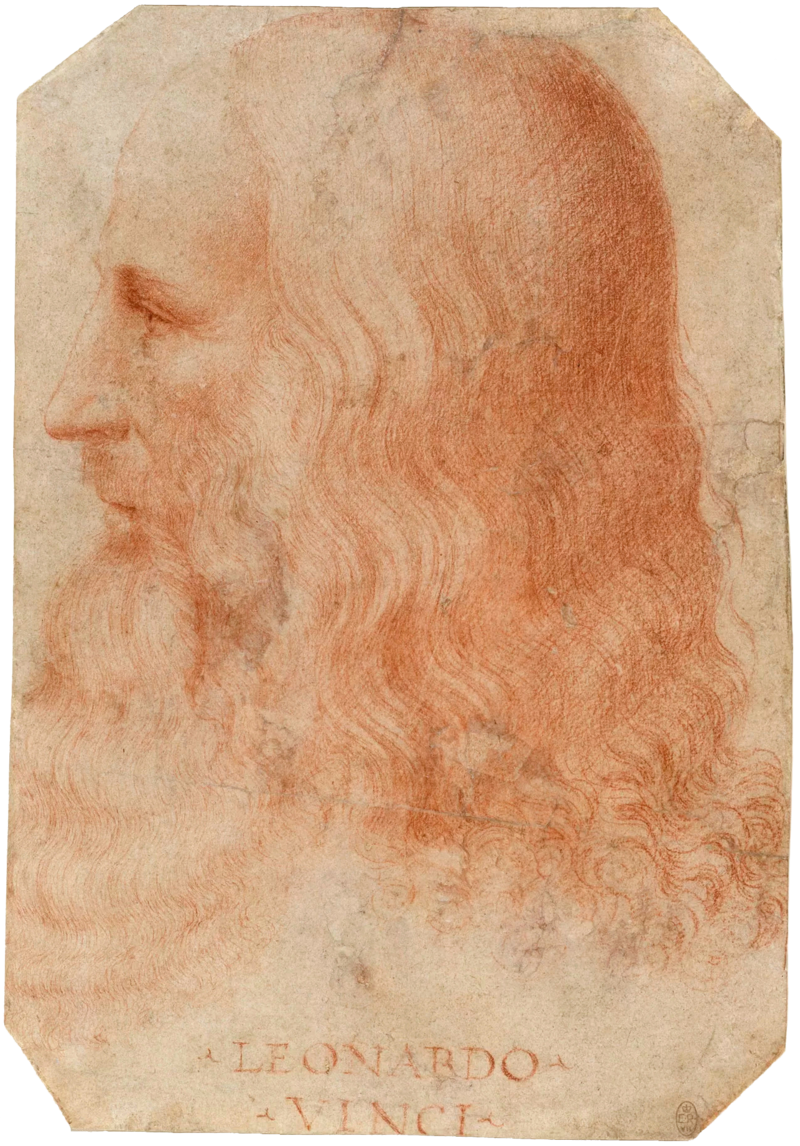
Author: Azur Ekić
Leonardo da Vinci is remembered as the embodiment of the Renaissance man—a painter, inventor, engineer, anatomist, musician, and philosopher. But those who have looked more closely into his life and legacy often feel there was something more behind his genius. It is no wonder that there exists a book called The Da Vinci Code, which, even though it is fictional, represents that exact feeling a lot people have – that Leonardo knew much more than he has shared to the public eye.
Before we delve into the mysterious world of Leonardo, let me share what I know about him from my Teacher. Firstly, and most importantly, he was an enlightened being. Secondly, he incarnated from the Elvish civilization that exists on Earth, though invisible to us, as the elves dwell in a much higher dimension. And thirdly, he is one of the rare beings who managed to contact the consciousnesses from the Ring of Olympus. With this short introduction, let us now explore the life of Leonardo—one of the greatest geniuses of all time.
A Mind Beyond the Veil
From an early age, Leonardo demonstrated traits that set him apart. He showed no interest in material wealth or social climbing. He was left-handed, wrote in mirror script, and had an insatiable curiosity that refused to be boxed into any one field. He was illegitimate and did not receive a classical education, yet his notebooks reveal a mind capable of absorbing and transforming the full spectrum of human knowledge. As one flips through the thousands of pages he left behind, what emerges is not merely a scholar or scientist but a seeker.
His studies in anatomy were so precise and reverent that many modern doctors still find value in them. But Leonardo wasn’t content with dissection alone. He seemed to be searching for the animating force behind the flesh—what some traditions might call the soul. This is evident in the way he combined form and metaphysics, body and spirit.
Vitruvian Man: The Divine Geometry of the Human Being
Perhaps no work of Leonardo encapsulates this better than the Vitruvian Man. Ostensibly a study of proportion, it is much more than that. The figure is positioned within a square and a circle—symbols often associated with matter and spirit, Earth and Heaven. To the casual viewer, it is anatomy. To the initiated, it is a mandala.

The idea that man is the measure of all things is ancient, but Leonardo gives it renewed depth. Here, he shows that the human body, when perfectly proportioned, reflects universal harmony. encoded within us—in our very geometry, what some traditions call sacred geometry. It is possible that Leonardo’s drawing was meant to be contemplative: a tool for meditation, or even initiation.
Salvator Mundi and the Hidden Christ
Another painting, Salvator Mundi, resurfaced centuries after it was lost to history. Depicting Christ holding a crystal orb, this image is serene yet enigmatic. The orb represents the cosmos, but unlike other representations, it contains no reflection or distortion. Some art historians were baffled by this, calling it an error. Others believe Leonardo knew exactly what he was doing.

Could the orb be a symbol of perfected vision—of seeing reality as it truly is, undistorted? Could the transparent sphere point to an enlightened state of consciousness, in which duality vanishes and one beholds the unity of creation?
Hidden Codes and Conscious Intent
The popular novel and film The Da Vinci Code may have exaggerated or fictionalized many aspects of Leonardo’s work, but the core suggestion—that he embedded hidden knowledge in his art—is not unfounded. His fascination with geometry, optics, anatomy, and symbolism is too deliberate to be accidental.
Leonardo designed machines that resemble helicopters and tanks, drew embryos in utero with astonishing accuracy, and used perspective to guide the viewer’s attention not just visually, but spiritually. He avoided religious dogma yet surrounded himself with sacred themes. He was fascinated with flight, not only mechanically but symbolically. To fly, in many mystical traditions, is to rise above the world of illusion.
The Silence of a Master
Leonardo rarely spoke of his beliefs. He left no clear spiritual manifesto. But perhaps this silence is itself a sign. Enlightened beings often do not teach in words but in presence, in work, and in symbol. Leonardo’s gaze, his sketches, and his subtle choices in art may have been his teachings.
He died in France in 1519, reportedly in the arms of the King. It is said he regretted not doing more. But maybe, like many mystics, he knew that the truth had to be veiled, encoded, preserved for those with eyes to see.
Conclusion: The Unfinished Code
In the end, Leonardo da Vinci remains a mystery not because of what he failed to say, but because of how much he implied. His life and work continue to inspire scientists, artists, and seekers alike. He was a man who saw the world differently—perhaps because he lived between worlds. And for those willing to look beyond the surface, Leonardo’s code is still waiting to be unlocked.