Seeing Beyond the Body: Krishna’s Timeless Teaching on the Soul
Author: Lea Kosovac
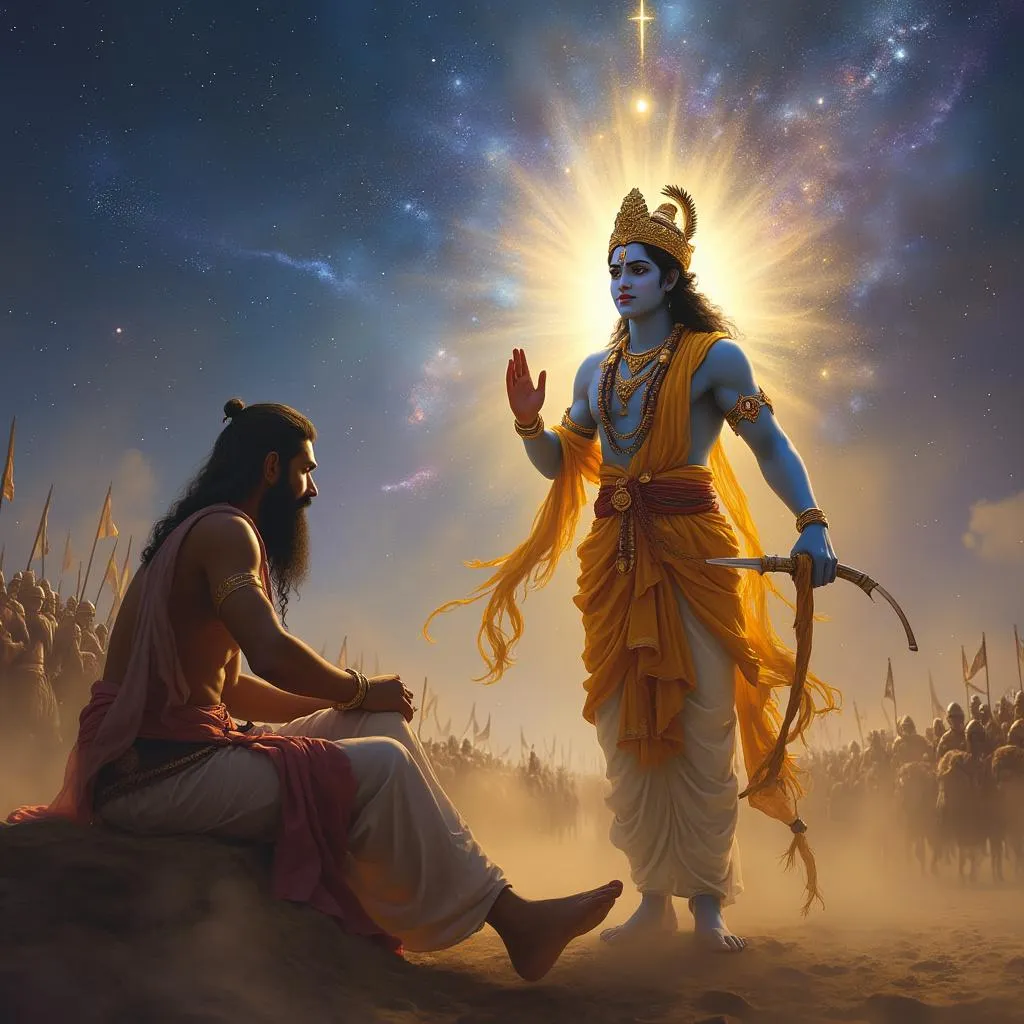
On the battlefield of Kurukshetra, Arjuna, the mighty warrior, faces a crisis unlike any other. Across the field stand his own relatives, teachers, and elders — family members he loves deeply. The thought of raising his bow against them fills him with anguish. “How can I kill my own kin? Even if victory comes, what joy is there in a kingdom built on the death of those I love?” His grief is both personal and moral: the destruction of dharma, the collapse of societal order, and the suffering of innocents weigh heavily on his heart. Overwhelmed, he lays down his arms, paralyzed by compassion and doubt.
It is in this moment of despair, when the human heart recoils from inevitable suffering, that Krishna begins to speak. His words do not dismiss Arjuna’s pain. Instead, they guide him — and all of us — toward a vision that transcends fear, attachment, and mortality. At the core is a radical insight: the soul (ātman) is eternal. It neither dies nor is born. The body may fall, the world may crumble, but our true essence remains untouched. Krishna reminds Arjuna that those he fears to fight against have already passed from the world of the senses; what we see as death is only the shedding of a body, the soul remains eternal and inviolable.
To hear this teaching is to face one of the most profound ideas in human thought: our truest essence cannot be harmed. The agony of fighting his own relatives is reframed — their physical forms may perish, but their eternal essence cannot. Krishna invites Arjuna to rise above immediate emotion, to act from understanding and courage, and to see the world not merely in terms of bodies and events, but in terms of the eternal reality behind all forms.
Vedantic and yogic traditions illuminate these verses further. Advaita Vedanta emphasizes the non-duality of ātman and Brahman: the soul is never born or destroyed, and realizing this truth dissolves fear and attachment. Samkhya philosophy distinguishes consciousness (purusha) from matter (prakriti), highlighting the soul’s role as the witness, untouched by the turmoil of the battlefield. The Yoga tradition interprets Krishna’s guidance as practical instruction: act without attachment to results, seeing beyond temporary forms to the eternal reality within all beings. In each interpretation, the teaching converges on the same profound principle: life and death are processes of the body, not of the soul.
For long-time seekers and practitioners, this teaching is not abstract theory. Swami Satchidananda (1924–2002), a renowned Vedanta scholar and teacher who studied the Gita for decades and founded Integral Yoga, emphasized: “The soul is never born and never dies; it is eternal. Understanding this truth is not mere philosophy — it is the foundation for fearless action and compassionate living.” Through meditation, reflection, and the observance of dharma, one can experience directly the continuity of the soul. Silence and contemplation reveal that the essence of life persists beyond birth and death, and even the most intense grief or fear becomes a doorway to understanding.
Dr. Sarvepalli Radhakrishnan (1888–1975), philosopher, statesman, and one of the most authoritative Western interpreters of the Gita, noted: “In every dilemma, the Gita teaches that action aligned with dharma, guided by knowledge of the self, frees us from fear.” His scholarship reminds us that Krishna’s teachings are both practical and eternal: they offer guidance in ethical decision-making and liberation from the cycles of attachment and suffering.
For ordinary people, Krishna’s teaching offers profound reassurance. The loved ones we fear to lose, the challenges that seem insurmountable, the fragility of existence — all are seen in the light of an eternal truth. Death is not annihilation; suffering is not final. We are invited to act with clarity, love, and detachment, knowing that life’s ultimate currents flow beyond the temporal.
Arjuna’s despair is our despair; his fear of harming those he loves is our fear of loss, mortality, and moral uncertainty. Krishna’s guidance transcends the battlefield: it is a teaching for every human life. To realize the eternal soul is to find courage in adversity, clarity in confusion, and freedom from attachment. By seeing beyond the transient, we understand the profound truth: the essence of all beings — ourselves, our loved ones, even those who seem like opponents — is eternal. The body may fall, but the soul endures. Krishna’s words, illuminated by centuries of scholarly study and lived experience, call us to rise, act, and live from that eternal truth, embracing the world with insight, compassion, and unwavering courage.