Author: Pradeep Krishnnan
Is there anything common between a spiritual master and a soldier? While the life mission of a mystical man will be the realization of God, the aim of one in uniform will be to protect his country and people. Curiously, what if an army officer becomes a well-known spiritual guru? A soldier’s experience in combat, discipline, and leadership can potentially translate into valuable spiritual teachings, particularly in areas like overcoming adversity, following a clear path, and cultivating inner strength. The guru’s role as a guide on a spiritual journey can be enhanced by the soldier’s understanding of the human condition and the challenges of life.
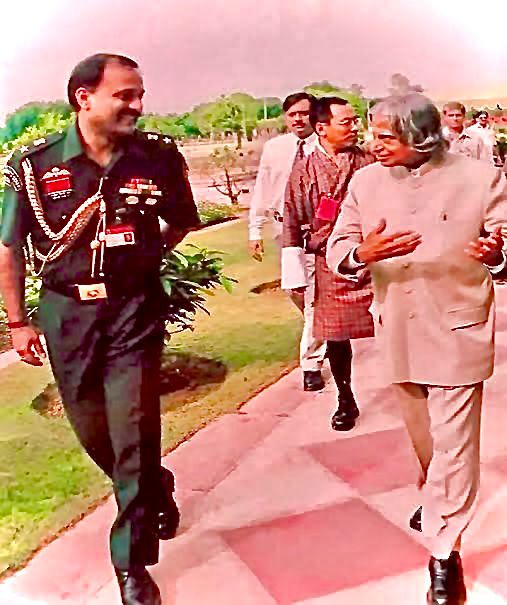
Such a Guru was named ‘Divine Colonel’ by none other than the late Dr APJ Abdul Kalam, the former President of India; his colleagues addressed him as a saint in uniform, and surprisingly, he had co-authored a bestselling book with his beloved disciple. At a glance, he looks like an ordinary man. But a moment of interaction, listening to his words of wisdom, would make one recognise the extraordinariness in him.
That exceptional master is Colonel Ashok Kini (63), a former Indian Army officer turned spiritual guru based in New Delhi. As soon as I read the book, In Quest of Guru, which he had co-authored with his disciple, Sri Matthew Zschoche, an American cinematographer, I longed to meet the spiritual duo. Surprisingly, the guru and the sishya came to Thiruvananthapuram to bless my wife, Sreelakshmi, and me.
The moments spent with them, at the hotel where they stayed, and the next day’s meeting at our home are still etched in our memory. The Guru-Shishya combination enthralled us not only with their words of wisdom on God, life, and living, but also enthused us with their jokes, culinary insights, and bhajans.
On my request, Sri Ashok Kini readily agreed to talk about his life, career, and spiritual insights. Born in Hosdurg, Kerala, a place associated with saints, Swamy Nityananda and Swamy Pappa Ramdas, right from childhood, thanks to his father’s association with the saints, Ashok Kini has a spiritual inclination. Soon after graduation, he joined the Indian Army as an Officer.
While in service, Colonel Kini had worked in several places in India and abroad and was decorated with several awards and honours. The Chief of Army staff commendation for outstanding services in 1998 in Angola in the UN peace keeping mission, Vishit Seva Medal by Dr APJ Abdul Kalam, then President for exemplary services as Comptroller of President’s household and Sewa Ratna by Kanchi Kama Koti Pitham for his service to humanity. Earlier, he had served in the Indian Peace Keeping Force (IPKF) in Sri Lanka, too.
Being a spiritual counsellor since 1998, Ashok Kini is popularly known as “Divine Colonel.” He considers most memorable the days spent with India’s 11th President, Dr. APJ Abdul Kalam, as the Comptroller of Rashtrapati Bhavan. About his stint, Ashok Kini said, “I consider my journey as a Divine Order to serve the People’s President, Dr. A.P.J. Abdul Kalam, Manushya Deva Roopena (A God in Human form).”
Recalling the interview Dr Kalam had with him in 2002 for the post, Colonel Ashok Kini said, “I sat face to face with the President. I was garbed in my ceremonial dress with medals and ribbons. He looked at my medals and said that they were very beautiful and asked me to explain each one. When I told him about the Nagaland medal, he thought for a while and asked me about the problem in Nagaland.” When informed that the main problem was that the top echelons of the administration were not interacting with lower-level people in the rural areas, making them feel neglected, Dr. Kalam ordered his State visits to Nagaland.
About his experiences with Dr. Kalam, Ashok Kini recalls, “Serving with Dr. Kalam for 3 years was all full of spiritual experiences. He treated every worker in the Rashtrapati Bhavan as a family member, showering us with love and care. I considered getting quotes from holy books from Dr. Kalam, as mantras of spiritual initiation. When my parents visited Rashtrapati Bhawan, he told them that they were lucky to have a son like me, and I am taking care of him as if I were taking care of them.”
About the book, ‘In Quest of Guru,’ co-authored with his disciple Ananda Mathews, he said, “Listening, understanding, and then penning down the knowledge requires tremendous patience and contemplation. Matthew has written all those teachings which are sought by the seekers in search of a guru to understand easily and thus become an enlightened human being in this life.” He considers the book as an attempt to showcase ancient Bharat’s wisdom of peace, brotherhood, and Universal well-being to all the spiritual seekers across the globe to create an enlightened global society. “Thus Bharat will become Vishwa Guru by guiding humanity towards spirituality,” he hoped.
In an exclusive interview with Pradeep Krishnan, he said, “Let us salute all saints and leaders, who promoted and lived in the spirit of Oneness and one world society (VasudevaKutumbakam). Let us chant the global mantra “VandeBhuMataram”, reassure our faith in Oneness, and follow the religion of humanity and move on the path of love, truth, and righteousness.”
Excerpts from the interview:
Guruji, could you please share your spiritual orientation?
Being born in a religious family living close to the Lakshmi Venkatesh temple, Hosdurg, Kerala, right from childhood, I was deeply connected with the deity Ma Durga of the temple, the nearby Nityananda Ashram founded by Baba Nityananda (an Avadhuta who later moved to Vajraeswari near Mumbai) and Anandashram, founded by Pappa Ramdas.
My parents got married after Nityananda Baba had verified and approved their horoscopes. One day, when my grandfather visited the ashram, Baba threw a torchlight at him in blessing. Keeping it in the puja room, he did Aarti to it every day! By flinging the ‘light,’ Baba brought prosperity and wisdom to the family: Not only did my grandfather’s small business improve, but all six grandchildren (three boys and three girls) excelled in studies.
Later, I was blessed by the late Swami Sudheendra Tirtha, head of the Shree Kasi Mutt, the organisation of our community, the Gowda Saraswath Brahmins. As a boy, I used to participate in the activities of Anand Ashram, founded by Swami Pappa Ramdas. Mataji Krishnabai of the ashram often affectionately held my hand and always insisted that I take food from the ashram before leaving.
Strangely, seeing people carrying dead bodies from a hospital near our school, I used to tell my classmates that in the future I would certainly invent a medicine to overcome death so that one can permanently remain in love and joy!
What prompted you to join the Indian Army, and please share your transformative experiences during the Kargil War?
While in school and college, as I was actively involved in RSS, NCC, and NSS, I had an affinity towards the defence services. While Mataji Krishnabai had once advised me to do Desha Seva, knowing that I wrote the CDS examination, Swami Sudheendra Tirtha blessed me, “You will surely get it.” I joined the army.
I soon joined the Indian Army as an officer and served in several places in India and abroad. The turning point in life came during the Kargil war (1999), while handling martyrs’ bodies: sending them to their hometown, arranging for cremation, and giving military honours. This period uplifted me to an elevated state. In one instance, intuitively, I was led to detect a wounded soldier in a military hospital in Delhi, whose name was erroneously considered for Param Vir Chakra (given posthumously). I realized that the divine was working through me.
On 25th May 1999, while attending a funeral, I felt a great surge of energy pulling my tongue out and writing something thrice on it. Though I didn’t take it seriously, for several months, there was a mark on my tongue! I considered it a blessing from the divine Mother, Ma. Thereafter, my words started becoming powerful and true. Handling of the bodies made me ponder a lot about life, living, and death. While the Kalinga war transformed King Ashoka, the Kargil war altered Kini Ashoka.
Handling the bodies, I often felt the pain and suffering of the bereaved family members. One day, a girl requested me to find out Captain Kangaroos, who was in the war field, and with whom she was engaged. On recognizing that his dead body is on its way to Delhi, utterly dejected, I rushed to Sri George Fuernandez, the then Defence Minister, seeking special permission for the girl to fly along with the body to Assam so that she can at least attend her beloved’s funeral.
Every day, Captain Bharatwaj’s father used to call me inquiring about his son, who was taken as a POW by the Pakistani forces. While consoling him and assuring him that his son would return to India soon, my spirit got connected to him as a son. So, during the Kargil war, the spiritual fire within me got ignited, churning me within.
Please share your memorable interactions with Dr APJ Kalam, the former President of India.
Two months after Dr APJ Abdul Kalam became President (2002), I was selected as the Comptroller of the President’s House (CPH). During the visit of Shri Jayendra Saraswathi, the Shankaracharya of Kanchi mutt, when I explained the protocol that an officer of the Rashtrapati Bhavan should welcome the saint at the forecourt and usher him to the President’s chamber and then the sanar acharya can be seated near the President’s chair in a visitors chair with a tiger’s skin placed on it, immediately Dr. Kalam asked, “Can I not receive the saint in the courtyard and make him sit in my chair?” When I explained that it would result in the Shankaracharya superseding the President in hierarchy, he kept mum.
However, on the day of the visit, while I was waiting in the forecourt to receive Shankaracharyaji, Dr Kalam rushed to the spot and welcomed the swamiji by garlanding him and offering fruits and flowers. Ushering the acharya to the President’s chamber, he directed to place the tiger skin be placed on the President’s chair for the saint to sit! Later, when I asked about a change in the protocol, Dr Kalam said, “I wanted the President’s chair to be blessed by the Shankaracharya. So, in the future, whoever sits in this chair will also get the blessings of the Shankaracharya.” That was Dr Kalam, himself a saint.
One day, while we were strolling in the Rashtrapati Bhavan Mughal garden, seeing the Jasmine flower (chameli) plant with buds and flowers, Dr Kalam asked, “Why should the flowers bloom and spread their fragrance?” I told him it was to make us understand Nature’s law; when the time comes, one has to bloom, spread the fragrance, and then fall down, i.e., to teach us about the cycle of birth, living, and death. The President smilingly told me that every flower should have a quest to get tied in a garland meant to be used in a temple, mosque, or a church. On his passing away, seeing people thronging to pay respects, I remembered his words about the flowers: Here was a great saint who spread fragrance of love, affection, and kindness all around. He taught us that we, Indians, irrespective of religion, should remain as flowers in a garland, sacrificing our lives for the nation.
During one of the visits to schools, when Ms.Vishnu Priya from Tiruppur asked him whether he believed in God, the President responded with a query: Why does the Earth revolve around its axis in 24 hours and rotates around the Sun in 365 days. To the astonished girl, he explained that for millions of years, the entire solar system moved around the galaxies in harmony without a hitch because of a ‘force’ that he believes is God.
One Diwali evening, after lighting the lamps in the Rashtrapati Bhavan forecourt, the President came down, took photographs, and gave the Diwali message. After a while, when I explained that the significance of lighting of the lamps was to welcome Ma Lakshmi, the goddess of prosperity, Dr Kalam smilingly said, “Before Lakshmi, I want Saraswati, the goddess of knowledge, to come to our nation,” revealing his commitment to bring education to the masses. Dr Kalam, in his public programmes, used to say that Bharat must become an educational superpower and always urged the youth, “A Sanskrit verse says that whatever be your aim, you will manifest. Dream high and get it fulfilled for the nation and the Earth. Then the whole universe would conspire to make it happen.”
Dr. Kalam used to say that learning, creativity, and thinking lead one to knowledge and ultimately make him/her great. One must use all avenues to gain knowledge. It’s knowledge. In Bharat since time immemorial, Satyam, Jnana, and Ananda are considered as Brahma. Unlike bank balance or property, the knowledge one acquires remains with one forever. Even after the body is gone, the soul will carry whatever knowledge one has gained till one attains the divine knowledge of self-realization.
Tell us about meeting Ananda Mathews, the emergence of the book, and the benefits of reading the book.
Mathew Sarkozy, as Ananda Mathews was known then, while undergoing difficulties in his life, as suggested by a Delhi Doctor, met me. On the first visit, for about an hour, we discussed his traumatic childhood as well as matters that were bothering and blocking his life. I found that he had to delete a lot of dark memories hidden deep within him.
Scriptures suggest that to delete the negative recollections, one has to perform prayashchittam (atonement). But spiritually, I did a sort of healing and told him to do certain practices. Soon, he got cleansed and was back in life, attending to his professional work as a cinematographer.
During one of our meetings, I suggested we pen down all his life experiences, right from his childhood days. As it was voluminous like a thesis, we edited it to make it 25% his life and the rest his spiritual journey, where I answered his questions. It dawned on me that his questions and my answers must be known to all those who have a spiritual quest. Then our recorded conversations emerged as a book. For Ananda, it was a sort of cleansing and healing. I am sure that anyone who reads the book gets transformed because of the energy contained in the words of the book. The book addresses questions on existence, spirituality, divinity, or God, or the Lord. Hearteningly, the book was appreciated by eminent persons like General G.D. Bakshi, Dr. David Frawly, and Sri Mohanji.
Initially, the reader may not grasp every word of the book. But if one reads the book with full attention and involvement, divinity will dawn on him/her. Several have written about their experiences of healing mental stress, solving life problems, immersing themselves in peace, and becoming spiritually inclined. Surprisingly, a Muslim girl told me that when she started reading a passage from the book, the fight in her home abruptly stopped. That is the power of the book.
Guruji, your thoughts on Guru –Guru-Guru-Guru-Shishya relationship?
To become a Guru, initially, one has to be a student and imbibe the qualities of a Guru. Merely watching a cookery show, though, will water one’s mouth, will not quench one’s hunger. To guide one to traverse the path of life smoothly, the support of an enlightened Guru, who can lead him to wisdom, is essential. I feel that Gurus, by sharing their knowledge, should strive to transform their shishyas into enlightened Gurus.
Nowadays, though it is difficult to choose a guru, when the student is ripe enough, the right Guru will appear. Because of his absolute surrender, I could make the Guru inherent in Ananda manifest and awaken him to the ultimate knowledge. For this to happen, to download the wisdom, the individual must be ready with a switched-on Wi-Fi modem and password.
A good student must always be ready to share and spread the knowledge he/she has acquired and should always be available to people. Like Swami Vivekananda, he should spread light for the nation and the world.
What is the core of your spirituality?
The core of my spirituality is sharing; of wisdom, happiness, and joy. Even praying for somebody is a noble act. The essence of Indian spirituality, a prayer for all humanity, ‘Sarve Janosukhino Bhavanto’ (May all people be happy), is enough to awaken the whole world. This teaching of Sanatana Dharma should be spread through books, talks, and interactions. The ultimate aim of one’s life should be to enlighten oneself and make others enlightened.
In this Kali yuga, the media is filled with stories of men becoming animals. The first step is to understand one’s dharma; one must become a human. The next step is to become enlightened, revealing the inherent divinity within.
Please share some of your experiences in psycho-spirituality.
Psycho-spirituality is a combination of spirituality and psychology, a science connected with positive words and actions. In the case of bodily ailments, in addition to the prescribed treatment, in psycho-spirituality, the patient is advised to pray to God for faster healing. However, in the case of mental issues, like depression, finding out the cause (which varies from person to person) is difficult. It is a paradox that nowadays no one has the time and patience to empathise with others. So, in psycho-spirituality, such a one is given a patient hearing, a sort of catharsis, to cleanse and heal their mind.
A family from Afghanistan brought me a boy, who was under psychiatric treatment for not being able to talk for the past 14 years. While I prayed intensely to Almighty Allah (the entity of a boy’s faith and belief), the name Fahida at once popped into my mind. As soon as I asked him who Fahida was, the boy’s face turned pale, and he quipped that Fahida was his girlfriend’s friend. As he was speaking after 14 years of silence, the whole family was shocked. Then I gently asked him who his girlfriend was. He said Farida, with whom he wanted to migrate to Dubai and settle. Since it could not happen, he was deeply depressed. He told me that one day, while lying in his house situated near a graveyard, seeing a Jinn (spirit) approaching him, he ran out of the room fast and stumbled over a rock he falling down, losing his faculty of speech. Then I advised him to practice certain pranayama techniques, which helped him to recover more than 80% of his speech. Incidentally, he kept on talking and did not allow anyone to sleep that night, because he was enjoying the speech that he had been waiting for after 14 years.
Another event was while visiting a patient in a Delhi hospital, all of a sudden, she got angry and was about to hit me. At once, when I took a small leaf from a nearby plant, crushed it, and threw it on her, she calmed down. She then thanked me for removing the evil spirit that had possessed her for a long time. Then I advised the family to do a pooja for all the ancestors. I advised the family to remember all the ancestors and do Pithru pooja.
Please tell us about your meeting with Ananda Mathews and the emergence of the book.
Ananda came to me while he was undergoing difficulties in life. Mathew Sarkozy, as he was known, as suggested by a Delhi-based doctor, had been trying to connect with me for some time. Usually, I avoid meeting people unless I get a clue from the Divine Mother. When the intention and the urge in ‘one’ is deep, he/she meets me.
On the first visit, he rushed to me on time and was surprised that I gave him an hour. We sat together, discussed his difficult childhood memories, and other matters that were blocking his life. He had to remove a lot of dark memories hidden deep within him.
According to the scriptures, to remove the recollections (bad deeds), one has to perform Prayaschittam (atonement). But spiritually, I have done a little bit of action-oriented healing. I told him to bring two oranges and asked him to pick one from my hand. When he did so, I took back the orange from him, prayed and wrapped it in a paper, and asked him to make it flow in the Yamuna River water, and gave the other orange to him to keep it for 40 days in his room, and then put it under a tree. He was cleansed and healed. I could bring him back to life, including his professional life.
One day, I suggested to him to pen down all his life experiences, right from the days of childhood, as far as he can remember. Once written, it came out like a thesis, voluminous. We edited it to make it 25% his life and the rest his spiritual journey. But his personal life was very sensitive. So the idea came to make it in a book form.. Spirituality came to him later because his quest started coming to ask questions that were not pertinent to him. Then I realized that his questions and my answers must be known by all those who have a spiritual quest. Then we started recording the questions and answers. I realized that it is not for him that he is asking; it is meant for others. That is how the book emerged. It was basically meant for his healing, and through him, the public healing. We had no intention of making it a copyrighted book. Anyone who reads the book gets transformed and gets the healing power of the Divine Mother and The Universal Guru because the book has energy in it. The book addresses questions on the existence, spirituality, and divinity of God or the Lord. The book received much acclaim from several eminent persons such as Brahmarshi Mohanji, Major General G D Bakshi, and Dr. David Frawley.
What are the benefits of reading the book?
Initially, the reader doesn’t need to understand every word of the book. If the reading is with full attention and involvement, then divinity dawns on him/her. Anyone who gets the book is highly blessed, as that is the first step to experiencing the Divinity. The book will give an experience of the Enlightenment. You know, somebody has rightly written that the book healed his mental stress. So everybody relates the book to themselves first. And secondly, if the book has come into their hand by way of reading or by recommendation of someone, I see that is the first step for that person to experience the Divinity or Divine atmosphere completely if the book is in their hand. And once you go through the book for whatever content it is, they can relate that experience to themselves, and so there are ways and means to become spiritual. Also, it is meant for the seeker, and the fact is that I am not forcing you to become a seeker. Just go through the book once, and then you will come to know if the book is meant to be in your hands. Overall, the book will give three meanings to you. One is normal reading to understand the personal point of view of the author. Secondly, you will try to correlate that maybe I can also get some kind of healing. Third is that Divine will play with you for a higher cause. It is happening. A Muslim girl told me that when there was a fight in her home, when she started reading a paragraph from the book, the fight stopped. That is the power of the book.
Your views on the reconsecration of the Ram Mandir at Ayodhya?
The consecration of the temple of victory gives every Indian immense joy and happiness. Everyone who attended the ceremony was moved. Rama is connected to Surya, who is connected to Atma. By installing the Rama idol, a representative of Surya has descended on earth. I am sure the whole Nation will get transformed within the next decade, heralding Ram Rajya, the Spiritual Nation Bharat.
Message to the readers
Understand that problems and difficulties are part of life. On the day of his birth, even Sree Krishna was separated from his mother and had to be nurtured by a stepmother. Being born as a human being in Bharat, the land of the rishis, itself is a blessing. The Fixed Deposits of your life are the punyakarmas (good deeds) that you do in this life. As each soul is potentially divine, realize your divinity.
Never get into worry and depression. Every day, be joyful, happy, and spread happiness, ananda, all around. Grab every opportunity to do something for society. I specifically named Mathews as Ananda, the one who spreads happiness to all. My parents have named me Ashoka, to take out the Shoka (sorrow) of people.
Message to the readers
Please understand that difficulties and troubles are part and parcel of life. On the day of his birth, Lord Krishna had to be taken away from his mother and was entrusted to a stepmother. So, do not worry and get depressed over anything in life; rather, be joyful every moment.
Never miss an opportunity to do something for the community and society. This Earth, this World, is entirely for people who are supposed to be spreading Ananda. That is why I named Matthews as Ananda, to spread happiness. My parents have named me Ashoka, one who is supposed to take the sadness out of people. Hence, I have been instrumental in taking the sorrows of people and showing glimpses of happiness.
Being blessed to be born as a human being in Bharat, the land of the rishis, one must aim to increase the Fixed Deposit of life by doing punyakarmas (good deeds). This life is an opportunity given by God to make us realize and get Enlightened. We must take this as Our Mission in Life.