By S. A. Rao-Rane, Research Fellow & Yoga Therapist
HISTORY OF THE VEDIC LITERATURE
Vedic science’s purity and simplicity of presentation of each text make the reading curriculum completely adaptable to students of all ages, from elementary to Ph.D., and completely accessible to students in the United States and worldwide, as far as the World Wide Web reaches.
The development of the ancient Vedic Literature as a reading curriculum appropriate for students of all ages, from elementary to Ph.D., requires the adaptation of more than 300 texts to the very specific demands of beginning readers. As a general rule, the published texts of Vedic Literature are intended for scholarly audiences, that is, for readers who are to a large degree fluent in thinking, speaking, reading, and understanding Sanskrit.
Contrariwise, student readers in Maharishi’s Vedic Literature reading program are trained only in the correct pronunciation of the sounds of the Devanågarī script. Fluency in recognizing and correctly pronouncing the letters of the Devanāgarī script is the starting point for entering into the curriculum of reading Vedic Literature.
The published literature provides many obstacles and hurdles for incorporation into the reading program, and indeed, there is no published text for any branch that is completely appropriate and acceptable for the reading curriculum. The ideal packaging presents each ancient text without introduction, without commentary or translation, without critical apparatus, and with a consistent and familiar Devanāgarī font.
The Vedic Literature reading curriculum and the Vedic Reserve texts grew out of the practical needs of the pioneering individuals who began to read through the entire Vedic Literature under the guidance of His Holiness Maharishi Mahesh Yogi.
“ॐ पञ्चमहभुतो साकरोजननिह पर्वतस्तनमण्डले मम बशयम कुरु कुरु नमः”
The five tanmatras, which are the subtle inner essences of sound, feeling, aspect, flavour, and odour.
Gravitational Force of Atom is the source of sound > Concepts Of Samkhya – Karika.
In a way, the Samkhya scheme is an inversion of the Western model where man and matter are just created. In contrast, what the Samkhya describes is not an act of creation but a process (vṛtti) of evolution originating from the most subtle towards the gross.
VEDIC LITERATURE
We began reading the Vedic Literature, skipping over the study of grammar, syntax, and other aids in understanding the meaning of the text, instead reading only for the sound value. Reciting the sounds of the texts of the Vedic Literature without regard for the meaning is an ancient technology of human development recognized by Maharishi as the real reason for the existence of the ancient science of phonetics, which he calls “Veda-lakshana.”
A mere recitation of the Vedic hymns in the proper way is believed to produce a spiritual effect irrespective of understanding the meaning of the texts recited. Though the knowledge of meaning is regarded as useful in the performance of the rituals by enhancing their effects, this aspect is usually ignored.
Maharishi explains that generally, recitation of the texts has been reserved for students learning the Veda in a procedure called “Adhyāyana,” where the student learns the Vedic texts traditionally maintained by his family. On the basis of Aithal’s testimony, it is evident that recitation of texts without regard to meaning is in accord with contemporary and historical practice.
However, the reading of the entire corpus of Vedic Literature encompasses:
- the four Vedas,
- the four Upavedas,
- the Vedāṅga and Upāṅga,
- the Brāhmaṇas, Āraṇyakas and Upanishads,
- as well as Itihāsa, Purāṇa, and Smṛti.
Sound = MECHANICAL WAVE + ELECTROMAGNETIC WAVE + MATTER WAVE or QUANTUM (SUKSHMA)
(Kinetic Energy + Static Energy = Potential Energy)
It is said that the evolution process detailed in the Samkhya is twofold: one cosmic and the other individual. Further, the outward process of the unfolding (sarga) is also meant to delineate the reverse process of absorption (apavarga). Samkhya considers evolution and absorption as processes that complement one another.
The evolution processes described in the Samkhya Karika are with particular reference to the individual.
- 33.3: The turbulence that takes place within the avyakta results in the guna rajas gaining the ascendancy; the rajas then activates sattva. And the two together overpower the inertia of the tamas and set in motion the process of evolution.
The Evolutes of Prakriti
- Mechanical Wave
- Transverse Wave
- Longitudinal Wave
- Magnetic Wave (Transverse Wave + Longitudinal Wave)
- Electromagnetic Waves
- Sound + waves
- Static energy is Shiva and Kinetic energy is Shakti = Potential Energy
- In a vacuum, electromagnetic waves travel with the speed of light.
- These waves can be polarized.
- They tend to have a transverse nature.
- There is no need for a medium to propagate E.M. waves.
- Momentum is present in E.M. waves.
- Matter Waves
In the symbolism of Lord Shiva (Atom Movement after Big Bang), we find Him portrayed as having five Faces Panchamukha:
- Frequency, or its inverse, wavelength
- Amplitude
- Sound pressure or Intensity
- Speed of sound
- Direction
Basic Five Elements of the Universe
(Space, Air, Fire, Water, Earth)
It is a divine and sacred 5 number that represents various subtle elements of nature—the Pancha Maha Bhootas—the creation of all-pervading Supreme Lord Sri Maha Vishnu, who is the Mahābhūtaḥ, the one and only mega presence in this universe. He is Bhūtātmā—one who dwells in all beings and is present everywhere.
In the Bhagavad Gita, we find Lord Sri Krishna elaborately explaining these concepts of subtle elements and their role.
Panchatva refers to death or decease; the human body is called Pancha-Bhoutika Sharīra, a compound of five vital elements (Pancha-tattva), and after death, the body merges with the Pancha Bhootas.
(COMPOSITE AND PRIME); DIRECTION
These five faces are known as:
- Eeshaana (facing skyward)
- Tatpurusha (facing east)
- Aghora (facing south)
- Vaamadeva (facing north)
- Sadyojatha (facing west)
Pancheshu is the name of Manmatha (Kaama), the god of love, as he holds five arrows corresponding to the five senses.
Sound is the creation of the Universe. Among the vibrational manifestations of transcendental reality, sound is the first and the subtlest. It is known as Tanmātra. The sonic Tanmātra is the first stage of manifestation. According to Sāṃkhya, Tanmātra is beyond the reach of an ordinary person; only a Yogi can perceive the Tanmātra.
Tanmātra (तन्मात्र)—n S: An archetype or subtle rudiment of any of the five forms of elementary matter: as gandha is of pṛthvī, rasa of udaka, etc. (see pañcamahābhūta).
Tanmatra is a vibration of sound, and sound is the source of creation of life. (Sound is +1 0 -1 = 0. Sound equals space, therefore Space = +1 0 -1.)
“The tanmatras form the Common Ground for the expression of the objective world and the entire world exists on this Ground.”
Another meaning of tan is mother, and matra means matter — the mother of matter. The Mother of this whole world is the tanmatras, which reside in the womb of the Cosmic Mother, Prakruti.
It is this energy that gives rise to the five objective elements. Each element is primarily related to one tanmatra but can contain portions of the others:
- Ether arises from shabda tanmatra (sound).
- Air arises from shabda and sparsha tanmatras (sound and touch).
- Fire arises from shabda, sparsha, and rupa tanmatras (sound, touch, and sight).
- Water arises from shabda, sparsha, rupa, and rasa (sound, touch, sight, and taste).
- Earth arises from shabda, sparsha, rupa, rasa, and gandha (sound, touch, form, taste, and odor).
Tanmātra(s) (‘subtle element(s)’):
According to Sāṃkhya ontology, the five ‘subtle material elements’ (sound, touch, form, taste, smell) evolve from prakṛti.
The gross elements are produced by various combinations of subtle elements. To illustrate:
- First to evolve is the tanmatra of sound (sabda), which produces akasha (space element), perceived by the ear.
- Shabda and sparsha together produce marut (air), which contains sound and touch, with touch sensed by the skin.
- Tejas (fire) arises from the essence of color (rupa tanmatra), combining sound, touch, and color, with sight perceived by the eyes.
- Water forms from shabda, sparsha, rupa, and rasa — sound, touch, sight, and taste sensed by the tongue.
- Earth combines all five tanmatras.
| Element | Sabda (Sound) | Sparsha (Touch) | Rupa (Form) | Rasa (Taste) | Gandha (Smell) |
|---|---|---|---|---|---|
| Akasha (Space) | ✓ | ||||
| Vayu (Air) | ✓ | ✓ | |||
| Agni (Fire) | ✓ | ✓ | ✓ | ||
| Apah (Water) | ✓ | ✓ | ✓ | ✓ | |
| Prithvi (Earth) | ✓ | ✓ | ✓ | ✓ | ✓ |
- Space = 0 → Sound = 0
- Air = Sound + Air
- Fire = Sound + Air + Fire
- Water = Sound + Air + Fire + Water
- Earth = Sound + Air + Fire + Water + Earth
Earth means earthly properties, wind means properties of wind, sky means ever-pervading space, fire means the energy of creation and destruction, and water means organic properties.
Thus, the objective world according to Samkhya Karika is made of twenty-four tattvas, each composed of varying degrees of the three Gunas: sattva, rajas, and tamas.
The term tattva comes from tat (that) and tva (you), meaning ‘thatness’ or the nature of a thing.
The Purusha (consciousness) is not a thing and is not treated as a tattva; Purusha is separate from everything else.
This distinguishes the Karika version of Samkhya from the older atheistic version and from later Vedanta-influenced versions.
The evolution projected in Samkhya–Karika proceeds systematically from the subtle, unmanifest state (avyakta) to the grossest physical element.
The ‘group of eleven’ (sense organs, organs of action, mind) and especially the antahkarana (intellect, mind, ego) act as a threshold between man’s inner and external worlds.
In the Samkhya model, the physical world appears only after the mind, senses, and their functions are established.
Samkhya ideology emphasizes reversing the trend of worldly existence to attain kaivalya (isolation/liberation).
This provided the framework for Yoga, Sri Vidya, and Tantra traditions.
The Sri Chakra model of creation and absorption (in Sri Vidya) sees the body as a nine-fold fort around the innermost Bindu (consciousness).
The aspirant follows samhara-krama, proceeding inward through various psychic states, refining thoughts and shedding conventional reality.
Bindu, the dimensionless point, just like avyakta in Samkhya, represents both the origin and end of existence.
Tantra followed Samkhya’s twenty-four principles but added twelve more to transform duality into unity. Tantra obliterates the subject-object duality, symbolized by Ardhanarishwara (Shakti and Shiva united).
Yoga Sadhana also mirrors the Samkhya model.
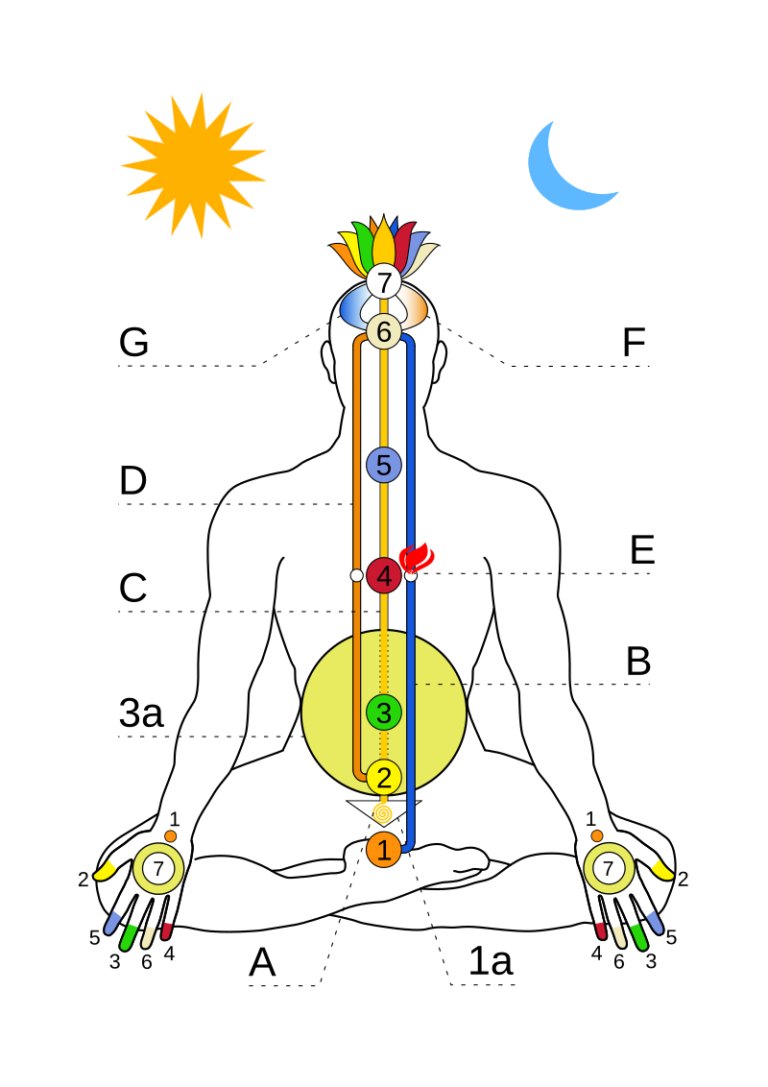
The yogi draws energy from muladhara (earth element) up to vishuddhi (space element). After purifying the elements, prajna ascends to ajna chakra, corresponding to:
- Manas (Chandra Chakra)
- Ahamkara (Surya Chakra)
- Buddhi (Agni Chakra)
- Avyakta Prakriti (Sahasrara Chakra)
In Yoga, the seer, seeing, and sight dissolve into one.
49.1:
The ultimate ground of human existence, according to Samkhya, is Purusha, pure consciousness itself.
One dwells in translucent consciousness — emptiness transcending manifest and unmanifest existence.
Realizing one’s nature as consciousness relieves bondage and suffering — this is the supreme goal of Isvarakrishna’s Samkhya Karika.
“Verily, therefore, the Self is neither bounded nor emancipated; No one is bound, no one is released. It is Prakrti alone, abiding in myriad forms, that is bounded and released.”
Guru Dattatreya accepted that he had 24 Gurus — the 24 elements of Samkhya philosophy.
In moving forward, doubts, confusions, wrong identifications, and misconceptions are shed. Truth prevails.
Age of Internet and Teachers:
Do we need teachers in the internet age?
Teachers refine, redefine, correct, expand, verify, and validate the learner’s thought process and remove blocks.
Learners must be ready; otherwise, teachers are no more than tape recorders and learners, parrots.
Peace and Harmony prevail by virtue.
Truth was revealed only to a select few.
Absolute Truth is about one’s absolute nature — SAT CHIT — before identification, before manifestation, before mind — just being.
It is not about understanding objects but shedding ignorance and being.
Today, in a mixed society, where there is a sincere seeker, realization happens.
Life skills are a one-time, subtle knowledge.
Where a sincere seeker exists, SATGuRu appears. Truth without SATGuRu is no Truth.
Every person we meet teaches us something — every person is a GuRu.
By the Grace of SATGuRu, one becomes aware of the eternal Self.
Only then does transformation happen.
Peace and Harmony prevail by virtue.