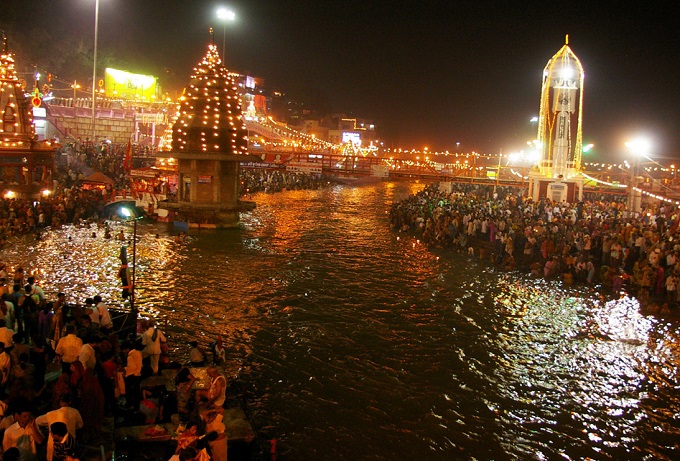
The Kumbh Mela (the festival of the sacred pitcher) is anchored in Hindu mythology. It is the largest public gathering and collective act of faith, anywhere in the world. The Mela draws tens of millions of pilgrims over the course of approximately 48 days to bathe at the sacred confluence of the Ganga, the Yamuna, and the mystical Sarasvati. Primarily, this congregation includes Ascetics, Saints, Sadhus, Sadhvis, Kalpvasis, and Pilgrims from all walks of life.
Kumbh Mela, in Hinduism, is a religious pilgrimage that is celebrated four times over a course of 12 years. The geographical location of Kumbh Mela spans over four locations in India and the Mela site keeps rotating between one of the four pilgrimages on four sacred rivers as listed below:
- Haridwar on the Ganges in Uttarakhand
- Ujjain on the Shipra in Madhya Pradesh
- Nashik on the Godavari in Maharashtra
- Prayagraj at the confluence of the Ganges, the Yamuna, and the mythical Sarasvati in Uttar Pradesh
Each site’s celebration is based on a distinct set of astrological positions of the Sun, the Moon, and the Jupiter. The celebrations occur at the exact moment when these positions are fully occupied, as it is considered to be the holiest time in Hinduism. The Kumbh Mela is an event that intrinsically encapsulates the science of astronomy, astrology, spirituality, ritualistic traditions, and socio-cultural customs and practices, making it extremely rich in knowledge.
Pilgrims to the Kumbh Mela come from all sections of the religion ranging from Sadhus (saints) and Naga Sadhus who practice ‘sadhana’ and keenly follow a strict path of spiritual discipline, to hermits who leave their seclusion and come to visit the civilization only during the Kumbh Mela, to seekers of spirituality, and to common people practicing Hinduism.
The origin of Kumbh Mela was transcribed by the 8th-century philosopher Shankara. The founding myth of the Kumbh Mela points out to the Puranas (compilation of ancient legends). It recounts how Gods and demons fought over the sacred pitcher (Kumbh) of Amrit (nectar of immortality) called the Ratna of Samudra Manthan. It is widely believed that Lord Vishnu (disguised as the enchantress ‘Mohini’) whisked the Kumbh out of the grasp of the covetous demons who had tried to claim it. As he took it heavenwards, a few drops of the precious nectar fell on the four sacred site we know as Haridwar, Ujjain, Nashik and Prayag. The flight and the following pursuit is said to have lasted twelve divine days which is equivalent to twelve human years and therefore, the Mela is celebrated every twelve years, staggered at each of the four sacred sites in this cycle. The corresponding rivers are believed to have turned into Amrit at the cosmic moment, giving pilgrims the chance to bathe in the essence of purity, auspiciousness, and immortality.
The story of Samudra Manthan, one of the best-known episodes in the Hindu mythology, narrated in the Bhagvad Purana states that the sacred alignments of celestial bodies directly relate to the Kumbh festival. It took 12 divine days to carry the Amrit to the heavens. As one divine day of Gods is equivalent to one year of the humans, the journey to the heavens symbolizes 12 years in human terms. That is why every twelfth year when Jupiter enters the Aries constellation on the day of the new moon in the month of Magh, the Kumbh festival is organized.
Content sourced from kumbh.gov.in
Feature images taken from: kumbhmela.com