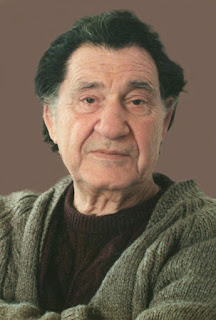
Author: Azur Ekić
Before you begin reading this text about the extraordinary Daskalos, one of the rare people that have managed to contact the Omega Ring of Olympus, you can experience his healing energy by clicking on this video, where Master Ljubiša brings this energy for the attendants of the Road to Enlightenment seminar.
A Childhood Marked by the Unseen
Stylianos Atteshlis, later known as Daskalos, was born in Cyprus in 1912. From early childhood, he displayed unusual awareness. According to accounts gathered by sociologist Kyriacos C. Markides in The Magus of Strovolos, young Stylianos could perceive non-physical entities and described vivid spiritual experiences that far exceeded the imagination of a child. He claimed to see beings that others did not and had insights about people and events that he could not have known through normal means. These early abilities did not fade with age—instead, they matured.
Formative Years and a Quiet Path
Despite his growing gifts, Daskalos led a relatively conventional outward life. He married, raised a family, and worked as a civil servant and translator. Yet throughout this period, he maintained an inner spiritual discipline and an ongoing relationship with what he called the “invisible worlds.” His mysticism did not isolate him from society—it ran parallel to it. He was a teacher, but not publicly known until much later in life, when Markides’ books introduced his name to a wider audience.
Healing and Paranormal Phenomena
Markides’ firsthand accounts of Daskalos include numerous reports of paranormal phenomena. These include psychic healing, telepathy, clairvoyance, and even materializations. In one striking example (Markides, The Magus of Strovolos, Chapter 9), multiple witnesses described a luminous, human-like figure materializing during a session, remaining visible for several minutes before fading. While such reports are extraordinary, Markides presents them not as folklore, but as events witnessed by educated individuals, often with scientific backgrounds, who did not seek publicity or personal gain.
Daskalos also performed spiritual healings in which he claimed to work through the “etheric double,” or energy body, of his patients. He would often speak about adjusting the inner structure of the person—not just alleviating symptoms but helping the soul’s evolution. His healing work was never done for money, and he was known for turning away those whose interest was rooted in curiosity rather than transformation.
Core Teachings and Structure
One of Daskalos’ central teachings was the distinction between the personality, the soul, and the Spirit. He taught that most people live identified with their personality—the everyday self shaped by memory and emotion. But true growth, he said, comes when a person begins to act from their higher Self, the Soul, under the guidance of the Spirit.
His framework also included detailed cosmology: multiple planes of existence, non-physical beings, reincarnation, and karma. However, he emphasized that spiritual development required direct experience and disciplined inner work. His instruction often included visualization, meditation, and a process he called “elemental cleansing” to dissolve thought-forms that distort perception.
Relationship with Markides and Public Exposure
Daskalos became internationally known primarily through Kyriacos Markides, whose books documented many of his teachings and interactions with students. Markides initially approached him with skepticism, intending to study him as a sociological subject, but over time came to accept many of the phenomena he witnessed. Their relationship is significant because it bridges the world of Western academic inquiry with experiential spirituality.
Legacy and Continuing Influence
Daskalos passed away in 1995, but his teachings live on through small groups around the world who continue to study his methods and apply them in their own inner work. His emphasis on integrity, verification through experience, and spiritual service has made his legacy durable, though not commercialized.
He remains a rare figure: someone who operated quietly, who reportedly demonstrated genuine paranormal abilities, and who consistently emphasized self-transcendence without dogma. For readers interested in mysticism grounded in discipline and precision—rather than vague inspiration—Daskalos offers a compelling example of what spiritual mastery may look like in the modern age.