Author: Jack Barratt
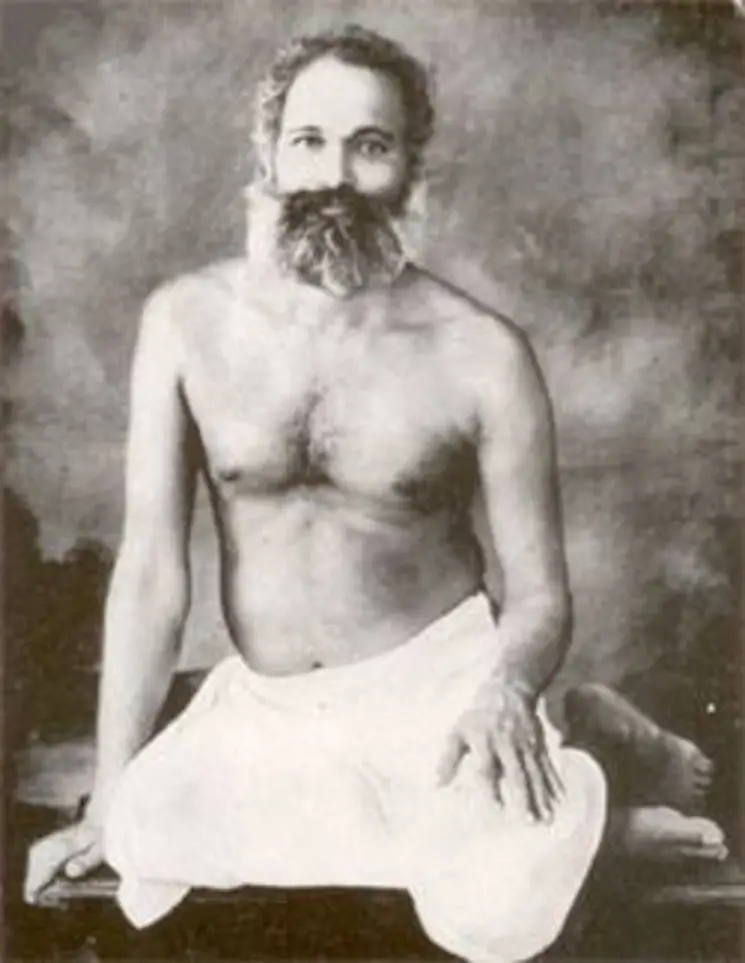
Shivananada Paramahamsa was a siddha master based in Kozhikode district, Kerala. Born as Raman Nambiar into a vegetarian Kshatriya family, apart from an incident of running away from home at age nine, his childhood was quite uneventful. He later married and took a job as a teacher and then later as a police constable.
The shape of his life shifted drastically one day when he returned home from work after receiving an urgent call from his wife. As he held her within his arms, she unexpectedly left the body. After this traumatic event, he began to question many things about life and eventually renounced his life in the mundane world.
He first went to meditate at the samadhi of Ramanujacharya, and later he found himself doing penance in a cave at Palani, home of the famous Murugan Temple. It was at Palani that Siddha Bhogar spontaneously manifested and initiated him into a method of spiritual practice that would later be known as Siddha Vidya. He then left for the Himalayas, and later received word to travel to Sharada Peeta in Shrigeri. At the Peeta, the 32nd Shankaracharya received telepathic instructions to hand over a number of items that belonged to Adi Shankaracharya, to the incoming sadhu. When the sadhu arrived, he was duly and ceremoniously presented the items and conferred with the title of Shivananda Paramahamsa.
Later, during his travels across India, he began to debate many pandits. The content of these debates lead to the creation of the book, Siddha Vedam. This book presents the philosophy of Siddha Vidya, which was seen as radical for the time as it challenged many religious norms. In the book, ideas such as the worshipping of idols, the existence of an external guru and the relevance of different discrete paths of yoga (karma, bhakti, jnana and raja) were challenged. The main conclusion of the book is that the only god to be worshipped is the life force that flows through us all. Without that life force, we can have
no knowledge of any god, guru or any method of yoga. The only goal of yoga, Swami tells us, is to learn to restrict the flow of the life force, and by extension the mind, from moving outside to engage with external objects. When the life force and the power of attention ceases to be dispersed, then that power is able to abide within itself. When that power abides within itself, it realises its own nature. In other words, when we stop obsessing with the internal and external objects, and we allow our life force and attention to rest within itself, we realise that we simply are just the flow of life, energy, pure attention. This is the philosophy of Siddha Vidya in a nutshell. Initiates of the path are also given a specific (kriya-like) breathing exercise to help internalise the life force.
A number of miracles were also associated with Swami. At one point, he reintroduced the program of mass feeding and fought for the rights of lower caste citizens to drink from the common water tank. When these people were beaten for from that tank, the wounds instead appeared the bodies of the attackers. Another time, a person suffering from elephantitis noticed the tejas emanating from Swami and began begging at his feet for mercy. Swami took a pinch of soil and asked the man to consume it and apply it on his feet. He was quickly cured. Once, while addressing a crowd in Chennai, Swami foiled a man who was looking to stab someone. With just one look in his direction, Swami prevented the man from moving and he was duly apprehended by authorities.
Swami was associated with, and empowered, a number of siddha masters of the time in South India. Perhaps the best known was the young Bhagavan Nityananda, who was still known as Raman at that time.
Shivananda Paramahamsa attained mahasamadhi on June 21, 1949 in Palani, the place of his initiation and the home of his guru.He still remains available as a presence for those thirsty for the presence and wisdom of siddhas.