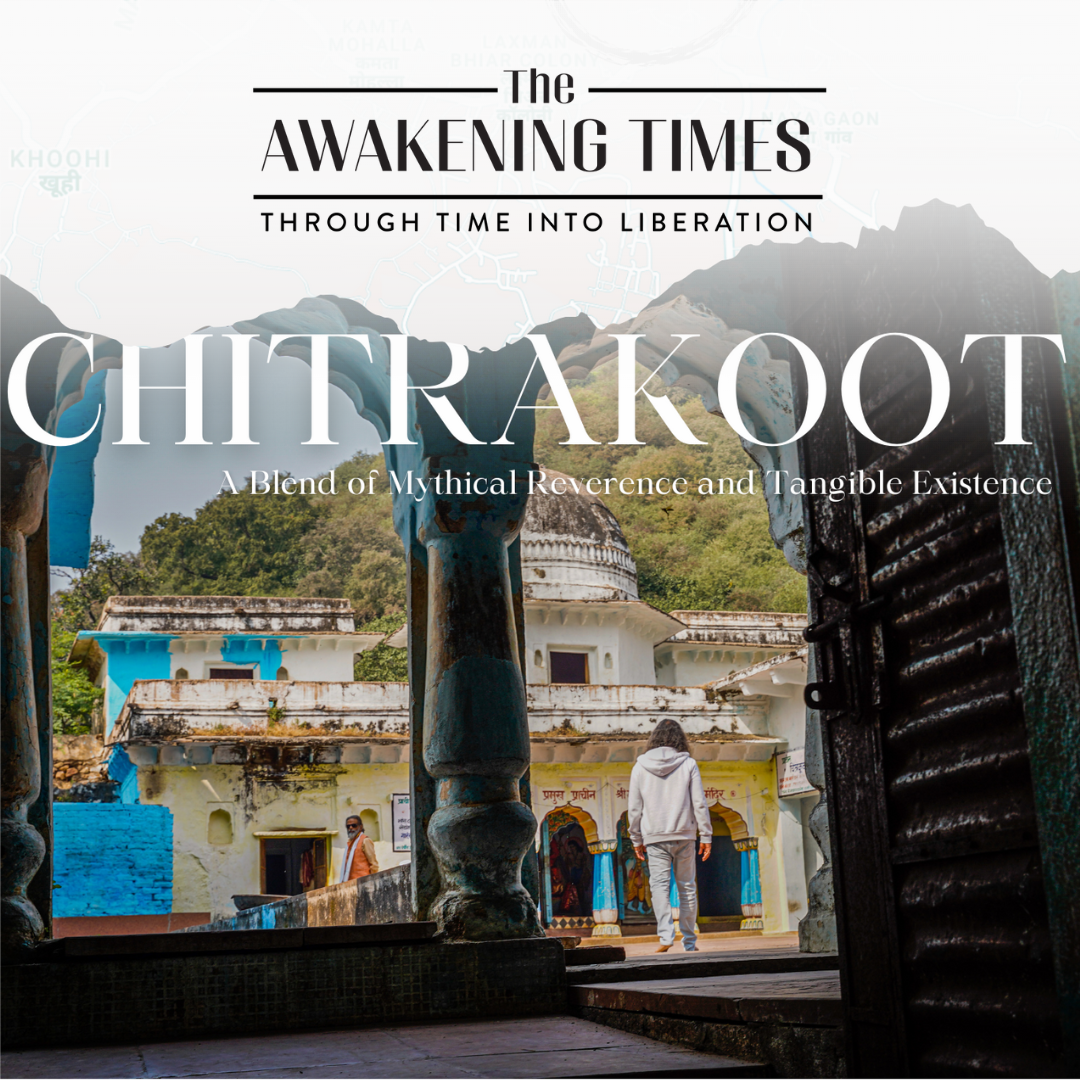
Chitrakoot, immortalized in the Ramayana, is where Lord Rama, the seventh avatar of Lord Vishnu, along with his consort Sita and brother Lakshman, spent 11 of their 14 years in exile. Today, the town feels like a living museum of this epic era, with every corner featuring shrines depicting Lord Rama’s court, complete with figures of Sita, Lakshman, and the devoted Hanuman at Rama’s feet.
This sacred place, often referenced by spiritual Master Mohanji, is considered the abode of Lord Hanuman, as he is believed to be eternally present wherever Lord Rama is revered. In November 2022, Mohanji visited this spiritual haven, and this article aims to share the profound experiences and insights from this remarkable journey.
Chitrakoot – A Spiritual Oasis
Nestled amid lush forests and rolling hills, Chitrakoot is a visual and spiritual spectacle. Its streets echo with chants of “Jai Siya Ram” (Hail Mother Sita and Lord Rama) and “Jai Shri Ram,” (Hail Lord Ram), while vibrant murals of the Ramayana grace its walls. The town is dotted with ashrams and frequented by a diverse mix of saints and seekers, adding to its mystical charm. The serene Mandakini river flows through Chitrakoot, further enhancing its celestial ambiance.
The heart of Chitrakoot is the sacred Kamadgiri hill, believed to be the residence of Lord Rama during his exile. Circumambulating this hill, known as the fulfiller of desires, is a deeply revered practice, believed to encompass all holy pilgrimages.
Mohanji’s Profound Bond with Chitrakoot
Mohanji’s reverence for Lord Hanuman, whom he sees as the epitome of devotion and surrender, brought him to Chitrakoot. He often describes Hanuman’s profound humility and unwavering devotion to Lord Rama in his teachings, emphasizing the non-duality of master and disciple.
Though familiar with Chitrakoot since childhood, my first visit alongside Mohanji promised to unveil unique aspects of this holy land. Our photographer, Thea, was particularly thrilled at the prospect of encountering Hanuman in physical form, inspired by Mohanji’s teachings and her own spiritual journey.
Embarking on the Journey
Our expedition to Chitrakoot, straddling the borders of Uttar Pradesh and Madhya Pradesh, began with a five-hour drive from Lucknow airport. A long-time follower of Mohanji, residing near Chitrakoot, had been inviting him for a decade, and finally, his visit materialized. Despite Mohanji’s preference for simplicity, the respect and hospitality accorded to spiritual leaders were evident, as we were provided a car used previously by local politicians, easing our passage through checkpoints.
Arriving at our cottage by the Mandakini river, the tranquility of Chitrakoot, even under a veil of fog, was instantly palpable.
The Kamadgiri Parikrama
Our first morning in Chitrakoot began with a breathtaking view of the Mandakini river. The day was dedicated to the parikrama (circumambulation) of Kamadgiri. Despite Mohanji’s recent recovery from an accident, he chose to walk the entire five kilometers, a decision hinting at deeper spiritual significance.
The pilgrimage path, starting at the Shri Kamtanath temple, is lined with shrines of various deities, ending with one of Shirdi Sai Baba – a reassuring presence for us. Mohanji’s intent for the pilgrimage was for the welfare of all beings, a theme that resonated throughout our journey.
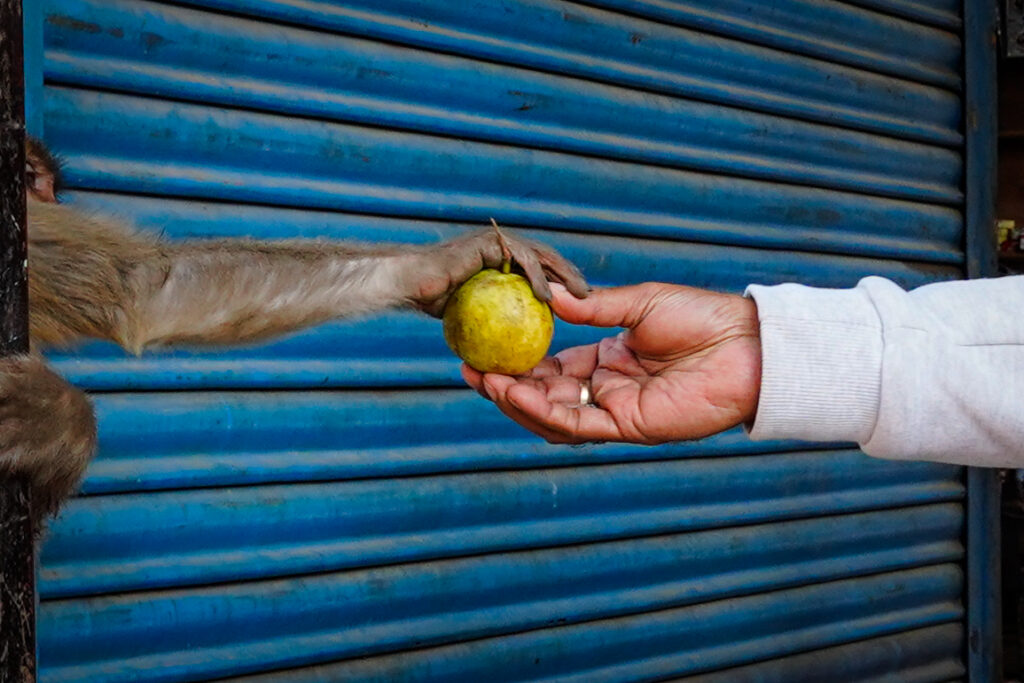
As we started the parikrama, we fed every being in sight generously – be it a dog, cat, goat, cow, monkey, or a human being. We had bags filled with biscuits and bananas. Our local hosts walked with us and arranged the food items to be distributed. They told us that monkeys loved raw brinjals (eggplant). We bought a few kilograms of brinjals from a nearby vendor and gave that to the monkeys. Soon, demand outstripped supply and we had to engage another push-cart vendor. Given the rate of our distribution, this vendor joined our parikrama group and walked with us all through the path, supplying brinjals as and when needed!


A Unique Harmony with Nature
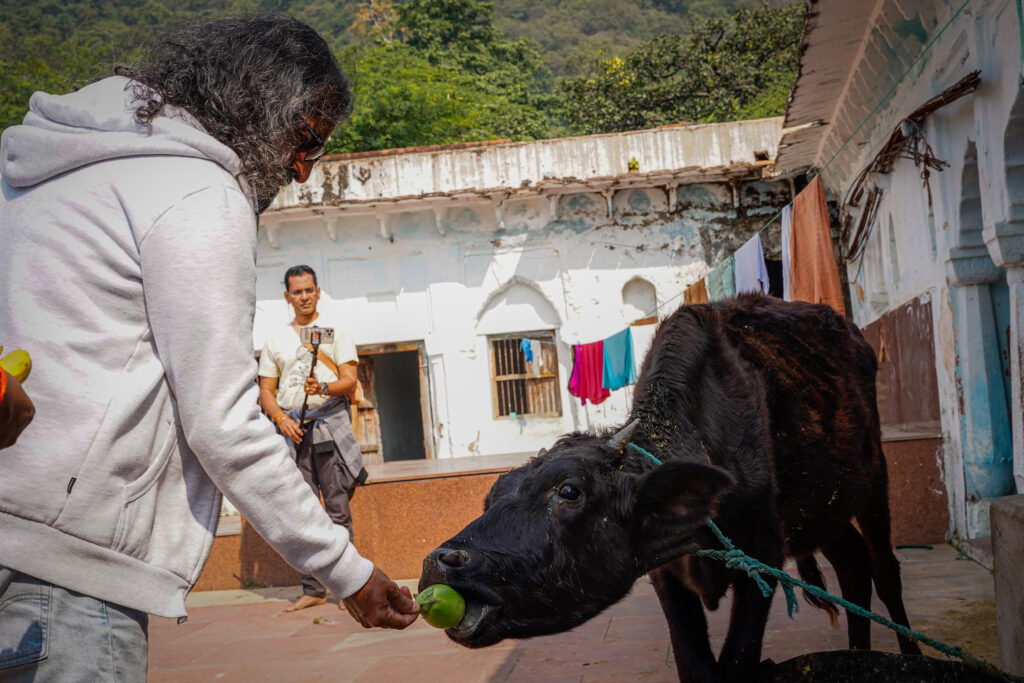
Along the way, we distributed food to the animals and the needy, observing Mohanji’s profound connection with each being. His interactions with animals, especially a particular monkey and a calf, were poignant. Mohanji’s feeding of these animals was more than an act of kindness; it was a transformative experience for them, as he explained their past lives and spiritual evolution.
Mohanji’s Impactful Presence
Witnessing Mohanji’s multifaceted actions left us in awe. What we witness is merely a fraction of his profound impact. At the surface, his act of feeding a monkey and a calf extended far beyond the physical realm. Mohanji often asserts, “No one comes within my presence unless I have something to deliver.” Every brief encounter with Mohanji is laden with immense grace and purpose. It’s a reminder for us to recognize these moments; each interaction with him is an opportunity to elevate our consciousness and spiritual awareness. Taking his friendly demeanor for granted would be our gravest mistake. Missing such an opportunity would not diminish him, but it would be an opportunity lost for us, sought after across lifetimes!
Embracing Universal Kindness
The incidents during our parikrama taught us the importance of kindness towards every being. Mohanji frequently emphasizes the Tradition’s potency: when even a single being aspires for liberation, a Master is sent to fulfill that longing. Dismissing any being as merely an animal, without understanding its karmic background, is our ignorance. That being might have been a higher being in a past life, now reincarnated due to karmic forces. By treating all beings with kindness, we align with a deeper universal compassion, a principle Mohanji constantly advocates: “Never miss an opportunity to serve another being. God and Guru can manifest in any form!”
Mohanji’s Compassionate Gestures
During our walk, Mohanji’s compassion extended beyond feeding animals. When he encountered sadhus in need of accommodation and animals struggling for sustenance, Mohanji swiftly orchestrated solutions. He arranged blanket distributions for the sadhus and initiated fruit tree plantations to support the wildlife, ensuring a sustainable ecosystem.
Connecting through the Ramayana
Amidst our parikrama, we stumbled upon an unexpected treasure—an old saint preserving the original Rama Charita Manas by Tulsidas, a priceless relic depicting the Ramayana in its purest form. Mohanji’s presence seemed to evoke a profound conversation from the saint, revealing insights into Lord Hanuman’s blessings and teachings.
The book was many centuries old. He explained that the Rama Charita Manas consisted of multiple books (referred to as kaand in Hindi which means section), dedicated to different stages of Lord Rama’s life. These books were preserved in three locations. This temple had 2 kaands, while the rest were distributed between the Tulsi mandir (temple) in Varanasi and a temple at Tulsidas’s birthplace, Rajapur.
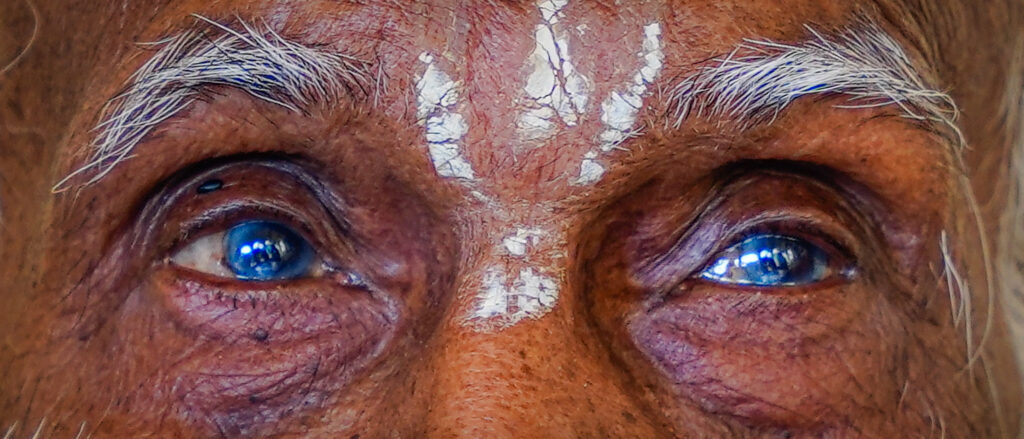
The saint fetched the manuscript from his cupboard and laid it on his table, allowing us to touch the well-preserved pages (encased in special sleeves to protect them from decay). He became deeply engrossed, telling us stories of Lord Rama and Lord Hanumanji. Mohanji gestured us to click pictures of him speaking and particularly to take close-ups of his face. His blue eyes glazed over, becoming almost transparent as he continued talking. Mohanji listened to him with rapt attention and a few minutes later, the saint looked away and ended the conversation. We offered him dakshina (an offering to a holy personage, in this case money), took his blessings and left. As we stepped out, Mohanji asked with a twinkle in his eye, “Did you notice how his eyes changed? Hanumanji spoke to us through him and blessed us.”
Our next stop was at another nondescript looking temple. The name board ‘Bharat Milap Mandir’ informed about its significance. This is where the younger brother of Lord Rama, Bharata, met his elder brother during his exile and requested him to return as Ayodhya’s ruler, discontinuing his fourteen-year exile. Being under renovation, we couldn’t see all the shrines. However, the main attractions in this temple were not the shrines but the gopuram (pyramidal spire) structure in the open courtyard that housed rock slabs with the imprints of the feet of Lord Rama, Bharata, Mother Sita, Lakshmana, and Shatrughna (another younger brother of Lord Rama), and Lord Rama’s mother Kaushalya. It is said that the fiery intensity of mutual brotherly love melted the stones capturing their footprints for eternity.
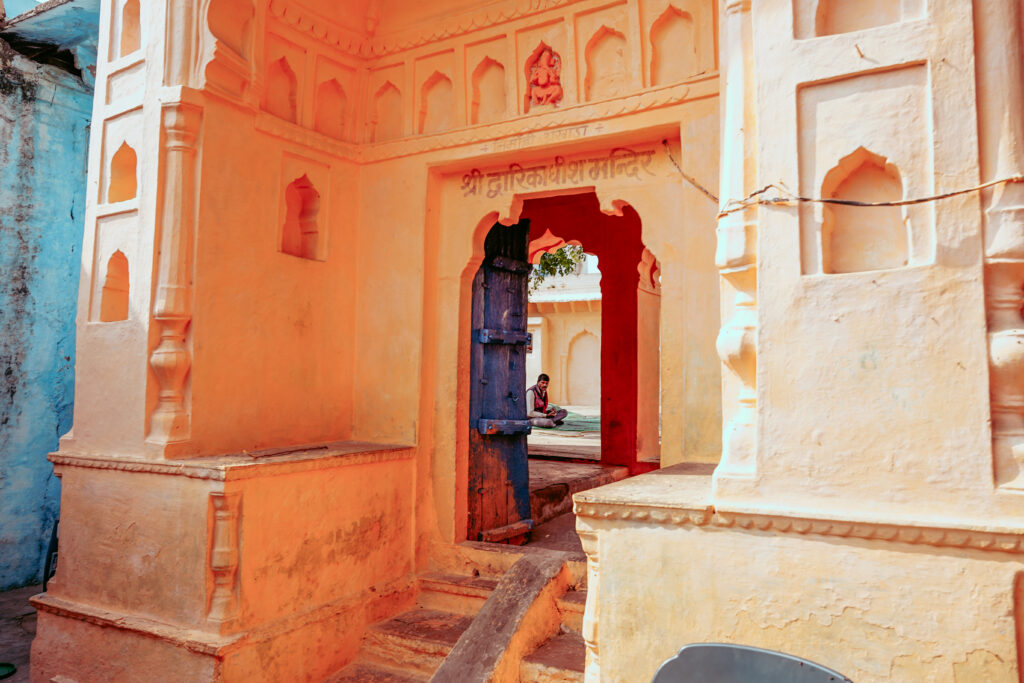
Continuing our journey, Mohanji’s words echoed the essence of these tales—living life in service and righteousness, embodying love and responsibility.
Transcending Perspectives
Our parikrama transcended mere pilgrimage; it became a celebration of life and compassion. Mohanji’s simple act of feeding beings fostered joy and contentment within us and the community around. His words revealed the profound cleansing that occurred—the absolution of the karmic sin of denying food to any being.
EpilogueThe Chitrakoot visit and the Kamadgiri parikrama provided an opportunity to connect to the Ramayana epic at a very personal level. Living in big cities, we lose sight of the incredible spiritual heritage of ancient, sacred Bharat. Chitrakoot reminded us that the wealth is ever-present and accessible to those who make the effort! It was also a gentle yet powerful reminder of Mohanji’s oft-repeated maxim that the purpose of our life is to add value to the world with every waking moment. When we do that, we change the world through our practice, not precept. Practice what you preach, then your practice becomes the preaching. Go not in search of Masters or God. Touch the lives of all those who come your way, and Masters and God will come in search of you.