Jovan Kurbalija’s Spiritual Path with Sai Baba
Jovan Kurbalija, deeply moved by Sai Baba’s teachings, unfolds his heartfelt connection in this interview. From the echoes of a grandmother preparing oil for Krishna’s massage in a distant past life to the simplicity of a spiritual journey rooted in love and service, Jovo’s narrative is a testament to the enduring impact of divine presence. His words paint a picture of a life shaped by the warmth of connection to Sai Baba, spanning across the ages and reflecting the timeless teachings of love and devotion.
The Awakening Times (TAT): Could you elaborate on how Baba has impacted your perspective on the coexistence of spiritual teachings and one’s religious faith?
Jovan Kurbalija (JK): I haven’t had any issues or doubts on this matter. And why? Before I learned about Sai Baba, I read many biographies of saints from various religions, primarily from the Orthodox Christian tradition. I especially want to emphasize St. Nikolai Velimirovic, the monks Siluan, Varsanufie, John of Kronstadt… and above all, my heart was touched by St. Seraphim of Sarov. These spiritual giants strengthened my Christian belief, and Sai Baba came as the icing on the cake, as the one who elevates Christianity and all other religions to a common planetary and cosmic level. This is best seen through the basic four tenets of His teachings: 1. There is only one religion – the religion of Love, 2. There is only one language – the language of the Heart, 3. There is only one caste – the caste of Humanity, 4. There is only one God – He is omnipresent. Therefore, Sai Baba sees planet Earth and all of humanity as a living organism in His Creation. In this living organism, different forms of existence manifest, appearing as different races, religions, nations, philosophical paths, but fundamentally, they all together constitute one organism in God’s Creation. So, I had no issues regarding religious affiliation. I could have been born in any race, religion, or nation – it’s completely irrelevant. What matters is that we adhere to God’s commandments…
TAT: Having had the privilege of traveling to Puttaparthi multiple times, experiencing Baba’s darshan, and being in His presence, can you describe the impact of those experiences on you? Additionally, could you share a specific anecdote or memorable moment from your time spent with Baba?
JK: Yes, during darshan, unexpected situations would occur. On one occasion, I was sitting in the front row with Dejan Bogicevic, Baba’s devotee from Belgrade. Baba was slowly coming, taking letters from devotees along the way. He reached us and stopped in front of Dejan. I extended both of my hands and touched His left foot. At that moment, Baba asked Dejan, “Where are you from?” Dejan replied, “From Yugoslavia.” Then confusion arose. I later understood that Baba was asking him, “How many of you are there?” Dejan was pondering, rolling his eyes, and said, “There are only three…” Shocked by Dejan’s response, I shouted to Baba, “There are 25 of us…” Baba then looked at me for a few moments without saying anything, but His gaze spoke volumes. I realized my mistake, lowered my head, and thought, “Jovane, you really messed up…”
TAT: Given that many individuals visit Puttaparthi, was it a challenging process for you to approach Baba and secure an invitation for an interview? If so, could you share some insights into that experience?
JK: Everyone who comes to Puttaparthi desires Baba’s attention, everyone! Devotees express this desire in various ways. Some loudly ask for an interview, while others uncontrollably throw themselves at His feet. Regarding myself, I didn’t succumb to such behavior. In my prayers, I surrendered everything to Swami, letting Him decide what and how things should unfold. Of course, I wholeheartedly wished for an interview. However, it didn’t happen. Nevertheless, something happened that gave me the opportunity for Baba to touch me voluntarily and impart words that all devotees long to hear from Him. During one darshan, Swami called Ružica from Belgrade for an interview. The men from our group didn’t witness that moment, but we saw Ružica sitting in front of Swami’s room, waiting to be called into the ashram. Voja from Belgrade, who visited Baba in Puttaparthi every year, seeing Ružica near Swami, grabbed my hand and said, “Let’s go, our Ružica is with Swami. Come quickly.” So, seven men from our region, jumping over devotees, rushed to the plateau where Swami stood. The security guards, signaling to the devotees, showed us where to sit. However, we immediately noticed that something was amiss. Ružica was sitting alone across from us, and we knew there were about 20 female devotees from our group. I pointed this out to Voja, and he replied, “Quiet, sit here. Don’t move; this is Swami’s play…” Of course, we stayed seated. Then Swami called a group of Germans for an interview, and they sat behind us. We expected Swami to invite us for an interview in the ashram. However, it didn’t happen. Swami came to us sitting in front of Him, took Voja’s hand, told him to stand up and move away. He did the same with others, leaving me sitting. As Swami escorted them a few meters away, mentally I addressed Him, “Please, Swami, I don’t want to sneak in; I’m not like that. Please, Swami, don’t play with me like this…” And He, Swami, approached me sitting in front of Him, bent down to my ear, and said, “Good boy, good boy…” While uttering these words, His right hand pressed firmly on my left shoulder blade. The pressure was incredibly strong. After His touch, a dark spot the size of a child’s palm appeared on my shoulder blade. It remained there for 12 years, and it constantly itched.
TAT: In the context of a guru-disciple relationship, how significant do you believe gratitude and maintaining a pure heart are, and why? Furthermore, could you elaborate on the role of persistence and perseverance in navigating the spiritual path?
JK: To answer these crucial questions, I will use Baba’s recommendation: “When you spiritually awaken, it is essential to develop patience.” Indeed, in addition to a firm commitment to consciously follow the spiritual path, patience is of utmost importance. What does that mean? Patience means not yearning for the results of our spiritual practice. We all eagerly want to see and feel the benefits of our spiritual efforts as soon as possible. But let’s know and be aware: no spiritual effort will go without a corresponding result. This is an axiom, a rule. So, let us regularly surrender to our adopted spiritual practice, and the results will surely come sooner or later! What is extremely important is to always, at every moment, be spiritually awake. Here’s a small example from my personal life. I was riding my bicycle on the streets of Novi Sad. I reached an intersection, and the traffic light was red. I waited for it to turn green to cross the street. When the green light came on, I started cycling to cross the intersection. However, a driver didn’t stop to let us pass but, violating the rules, rushed to cross the signal… We, cyclists and pedestrians, stopped in fear due to the reckless behavior of the driver. I shouted to him, “You’re not normal…” Immediately after uttering these words, I became aware that I had made a mistake. When I crossed the street, I stopped and mentally addressed Baba, asking for forgiveness for my negative comment. Because I added my negativity through a bad comment to the negativity of the driver. This increased the amount of negative energy, and that is not good. That’s why I am grateful to Swami for reaching a level where I can immediately notice my own negativity. Of course, sincere repentance follows immediately, and the intention not to repeat the mistake. Our spiritual Teacher knows our every state and whether our prayers and repentance are sincere. Therefore, trust and faith in the spiritual Teacher are very important and crucial. There should be no reservations.
TAT: Could you share an experience where you had a dream in which Baba appeared to you, and it left you with an interpretation suggesting that it might signify a transition or departure from the physical body in the near future?
JK: First, I must say what Swami thinks about dreams. He literally says: “Real are those dreams that are related to God. If you see Me in a dream and I allow you to make Namaskar (bow at My feet), I give you a blessing and bestow grace upon you… that is true because it is My will and the result of your spiritual discipline. If the Lord or your Guru appears to you in a dream, it must be the result of God’s Grace, not something else. Such a dream can never be the result of your desire.” So, these are true dreams. I had a total of 61 dreams with Sai Baba. That was truly impressive. He always came to me in a dream after certain spiritual efforts, at times when I had dilemmas in my spiritual practice. And so it happened that He came to me in a dream on September 21, 1999. That was the day when Orthodox Christians celebrate the Feast of the Mother of God (Small Gospojina). I dreamt: Sai Baba entered through the window into my attic room, closing the window behind Him. Completely surprised, I addressed Him, “Swami, what should I do; the Creator is with me, tell me what to do?” He raised His index finger upwards and said, “Don’t live for long.” I looked at Him in surprise and asked, “Swami, is five years too much or too little?” Again, He raised His index finger higher and said, “You don’t need a long life.” So, the dream was on September 21, 1999, and I said five years. This means that I should leave the body on September 21, 2004, or as people say: that’s when I should die. I thought about it and decided not to tell my wife or sons about my dream. When that date approached, I would inform my family. From that moment on, I started meditating, chanting, and praying more. It was a marvelous time, just like that: marvelous! The more and more I meditated, the more beautiful it became. There was no fear of the upcoming event; on the contrary, it became more and more pleasant. Time passed, and September 21, 2004, was approaching. Just before that date, Swami came to me in a dream, raising His index finger higher, and said to me, “I haven’t finished with you yet.” The dream took place on Bulevar Oslobođenja in Novi Sad near the “Dalton ” building, close to Futoška pijaca. I asked Baba, “Tell me what to do. Can it be today, tomorrow, or the day after tomorrow… tell me, Swami.” He just said, “No, not now,” and went towards the market. After these words of Baba, I remained somewhat confused. The intensity of my spiritual practice gradually decreased, and time passed.
TAT: In addition to being in the presence of Baba, you also had the chance to meet the esteemed saint Devi Amma in Bangalore, India. Could you share your experience of meeting Devi Amma and the impact it had on you?
JK: I went to Puttaparthi again in early December 2009 and stayed there until the end of February 2010. I was accompanied by Ivan, a mechanical engineer from Zagreb, Sekula Dobric, an economist from Rijeka, and Dr. Dragan Dzoljic from Belgrade. They often persuaded me to go to Bangalore to meet Devi Amma, whom Sai Baba had initiated in 1973. I wasn’t particularly thrilled with that idea; I relied on Baba’s words: “The future is uncertain, the past is behind you, be vigilant and live in this moment…”. However, in the end, I agreed to go to Bangalore with them. But before that, I compiled 29 questions for Devi Amma. The questions were about me and members of my family, my wife, sons, grandson, and my deceased parents. I wasn’t entirely convinced that I would believe in Devi Amma’s answers. However, she gave some answers to which no one but me knew. And I hadn’t told her anything. Here I will share only some of Devi Amma’s answers to three questions that I find very stressful, not to say shocking… To my question: Did I live during Krishna’s time? Devi Amma replied: “Yes, you lived with Him. Your mother from this life at that time was your grandmother who prepared oil for Krishna’s massage, and your massage teacher was your current younger son (by the way, my younger son Bojan is involved in massage in this life). Krishna allowed only you to massage Him. When Krishna went to Dwaraka, you did not go with Him…”
What to say after this response from Devi Amma? To say I was shocked would be an understatement. And to my question: What happened to my father? With a sad expression on her face, Devi Ama replied, “Well, that’s a concentration camp… they are all hungry… like living skeletons… oh, they destroyed them all… Karma with him is finished.” (My father was taken to Concentration camp Stara Gradiška in July 1943, where he was liquidated.) After this response from Devi Amma, my doubt in her words diminished.
But this was not the end of the shocks I experienced that day with Devi Amma. The biggest surprise followed. On my question: Where was I born and lived in my previous human body? The answer that followed simply froze me. Devi Ama said, “You were born in Puttaparthi. You had six years of intense companionship with the boy who would become Sai Baba. When Sai Baba went to another town for education, you, in sorrow for Him, jumped into a well and drowned. Baba wasn’t there to save you.” After this answer, I asked Devi Amma an additional question: “Does that mean I am the child from the well that Sai Baba talked about in His book about His early childhood? Devi Ama briefly said, “Yes, you are the child from the well.” What to say after such a statement? I tried with all my might to hold back the tears that surged through closed eyelids. Nothing could stop them.
TAT: Finally, can you share with our audience what is the most important teaching or message of Sathya Sai Baba for you?
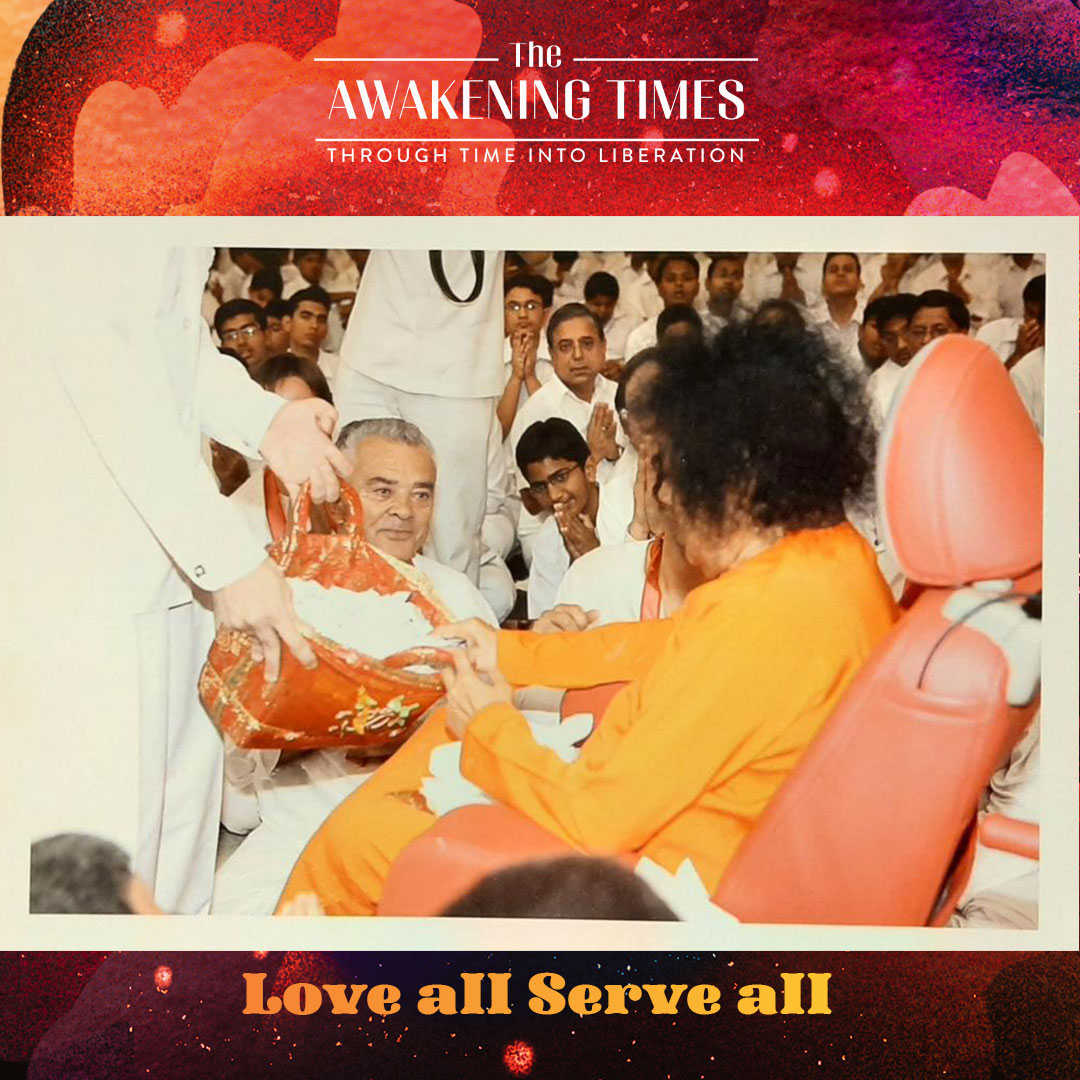
JK: It relates to the four basic tenets of Sai Baba’s teachings. As for Baba’s message, it is inscribed on His grave: LOVE ALL SERVE ALL.
May all of God’s blessings be with you and your viewers and readers.
Sai Ram.